Logo Wordmark RevealEnding
HyperFrames and Remotion both turn code into MP4 video and both ship agent skills for Claude Code and Codex. HyperFrames uses HTML, CSS and GSAP under Apache 2.0. Remotion uses React and TypeScript, and it is free for individuals and companies of up to 3 people, with paid licences above that (terms checked on 16 November 2026).
| HyperFrames | Remotion | |
|---|---|---|
| What you write | HTML, CSS and JavaScript, with timing set by data attributes and a paused animation timeline | React and TypeScript components that read the current frame number |
| Licence | Apache 2.0 | Remotion's own licence: free for individuals and for-profit companies of up to 3 employees; paid above that |
| Cost for a company with 4 or more people | No licence fee. HeyGen-hosted voices, avatars and cloud rendering bill through HeyGen accounts | Creators $25 per month per seat. Automators $0.01 per render with a $100 monthly minimum. Enterprise from $500 per month |
| Local rendering | npx hyperframes render; needs Node.js 22+ and FFmpeg | npx remotion render; H.264 by default, other codecs with --codec |
| Cloud rendering | HyperFrames Cloud, your own AWS Lambda or Google Cloud Run | Remotion Lambda on AWS; Cloud Run is named as an alternative |
| Agent skills | npx skills add heygen-com/hyperframes, or a Claude Code plugin | npx skills add remotion-dev/skills, or npx remotion skills add in a project |
| GSAP | The primary animation runtime | Available through the @remotion/gsap package |
| Existing web material | HTML, CSS and GSAP or Lottie animations usually drop in close to as they are (HyperFrames docs) | Rewritten as React components (HyperFrames docs) |
A Remotion video is a React component. The component reads the current frame number with useCurrentFrame() and returns what that frame looks like. A three-second title fade is written in frames, for example with interpolate(frame, [0, 15, 75, 90], [0, 1, 1, 0]) at 30 fps.
A HyperFrames video is an HTML file. Elements carry data-start, data-duration and data-track-index attributes that say when they are on screen, and a GSAP timeline created with paused: true says how they move. The timeline is registered on window.__timelines under the composition id. The renderer seeks the paused timeline to an exact moment before it captures each frame, so GSAP, Web Animations and Lottie render the same way every time. The same title fade is written in seconds.
HeyGen's own comparison gave Claude Code the same one-paragraph request for a 15-second launch video, once with only Remotion's skills and once with only HyperFrames' skills. One run each, nothing edited afterwards: 12 minutes 30 seconds and 10 TypeScript files for Remotion, 11 minutes 50 seconds and 4 HTML files for HyperFrames. The page states that a single run decides nothing about quality. HeyGen makes HyperFrames, so read it with that in mind.
Remotion terms below were read on remotion.dev on 16 November 2026. Check the page before you decide, because the licence text says it will change slightly in Remotion 5.0.
HyperFrames is Apache 2.0 for the framework, CLI and skills. Rendering on your own computer is free and needs no account. The HyperFrames FAQ lists a free Studio app plan and a Pro plan at $25 a month. Fonts, music and footage you add keep their own licences.
Both tools render locally from a command line. HyperFrames seeks frames in headless Chrome and encodes them with FFmpeg. Remotion's render command takes a composition id and an output path, and supports h264, h265, av1, vp8, vp9, prores, gif and audio codecs.
For cloud rendering, the HyperFrames docs list HyperFrames Cloud (npx hyperframes cloud render), AWS Lambda and Google Cloud Run in your own account, plus a Producer package for Node applications. Remotion documents Lambda, which splits a render across many functions and stitches the parts together, and mentions Cloud Run as an alternative.
Remotion's official skills include remotion-best-practices, remotion-create, remotion-markup, remotion-studio, remotion-render, remotion-captions and remotion-license. The docs name Claude Code, Codex, Cursor, Kimi Code and OpenCode among the supported agents.
HyperFrames publishes nine skills. The core set is hyperframes, hyperframes-cli, hyperframes-registry, media-use, reverse-any-video and style-sampling, with figma, slideshow and remotion-to-hyperframes installed on demand. The last one brings Remotion code or footage into HyperFrames and checks the result frame by frame. For Claude Code the docs give claude plugin marketplace add heygen-com/hyperframes followed by claude plugin install hyperframes@hyperframes. More on this route is in Claude Code video skills and Can Claude make videos?.
GSAP normally runs on the wall clock. HyperFrames builds its compositions around a paused GSAP timeline that the renderer seeks. Remotion needs every frame to be a pure function of useCurrentFrame(), and its @remotion/gsap package builds a paused GSAP timeline and seeks it to the current frame. The package needs gsap installed as a peer dependency and is available from Remotion version 4.0.517.
Two other tools make video from code. Motion Canvas is an MIT-licensed TypeScript library that uses generators to program animations, with an editor for real-time preview. Revideo is an MIT-licensed rendering engine for creating videos in code; its README says it borrows concepts from Remotion, and scenes are TypeScript generator functions.
Motionboard has 38 free recipes, each a film of about 10 seconds made with HyperFrames and GSAP and shown next to the launch film it recreates. Three of them are below.
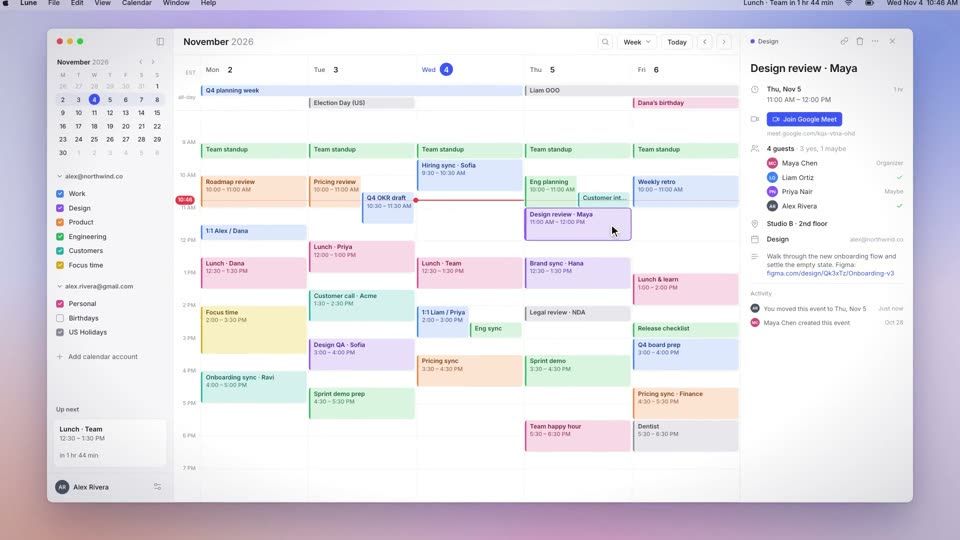
Install the recipes in Claude Code or Codex with the command below.
npx skills add krisyangdev/motionboardAs of 16 November 2026, the Remotion Free License covers individuals, for-profit organisations with up to 3 employees and non-profit organisations, including commercial use. Larger companies need a Company License: Creators at $25 per month per seat, or Automators at $0.01 per render with a $100 monthly minimum. Check remotion.dev/license for current terms.
The HyperFrames FAQ says the Apache 2.0 licence lets you use, change and distribute HyperFrames, including in commercial work, under its terms. Media you add keeps its own licence. HeyGen-hosted features such as voices, avatars and cloud rendering bill through HeyGen accounts.
Yes. Remotion's @remotion/gsap package builds a paused GSAP timeline and seeks it to the current frame. Install it with npx remotion add @remotion/gsap and install gsap as a peer dependency.
The HyperFrames repository lists a remotion-to-hyperframes skill for bringing existing video code or footage into HyperFrames, starting with Remotion. It verifies the result frame by frame against the original.