11s
Motionboard recreation · no launch-film original
Transitions · 10.4s film
Light Leak Transition
A soft orange, amber and magenta glow drifts in from one side of the frame, peaks near white on the cut frame, and the next screen develops out of the overexposure. It happens twice, ending on the lockup.
How to make a Light Leak Transition with Claude Code or Codex
Copy the recipe above and paste it into Claude Code or Codex. The agent installs the skill and builds the shot.
npx skills add krisyangdev/motionboardHow it's built
Build the leak from seven large radial gradients with different sizes, colors and paths, layered above the scene with mix-blend-mode screen: orange 1800x1300px, amber 1300x1000px, magenta 1000x1500px, a near-white core, a narrow streak with 24px blur, and two edge glows. Each one moves from off-screen with its own ease (power3.out, power2.out, power1.out, power1.inOut) from about 1s before the cut to about 1.5s after it, so the shape stays organic.
Put the scene swap on the brightest frame. A near-white flash layer rises to opacity 0.98 over 0.46s (power3.in) and holds for 0.08s around the cut, while the outgoing scene lifts to brightness(2.3) contrast(0.82) saturate(1.3). The cuts are at 2.8s, 5.7s and 8.3s; the incoming scene eases back to normal over 0.9s (power2.out) and its elements develop out of the overexposure. Raise film grain from 0.5 to 0.85 during the leak.
Press the copy button to send this recipe to Claude Code or Codex, or install the skill once with npx skills add krisyangdev/motionboard. The agent builds the phone, the gallery, the picker and the leak for your own screens. Render an MP4 with HyperFrames, or port the GSAP timeline to your website.
Full recipe
Why it works
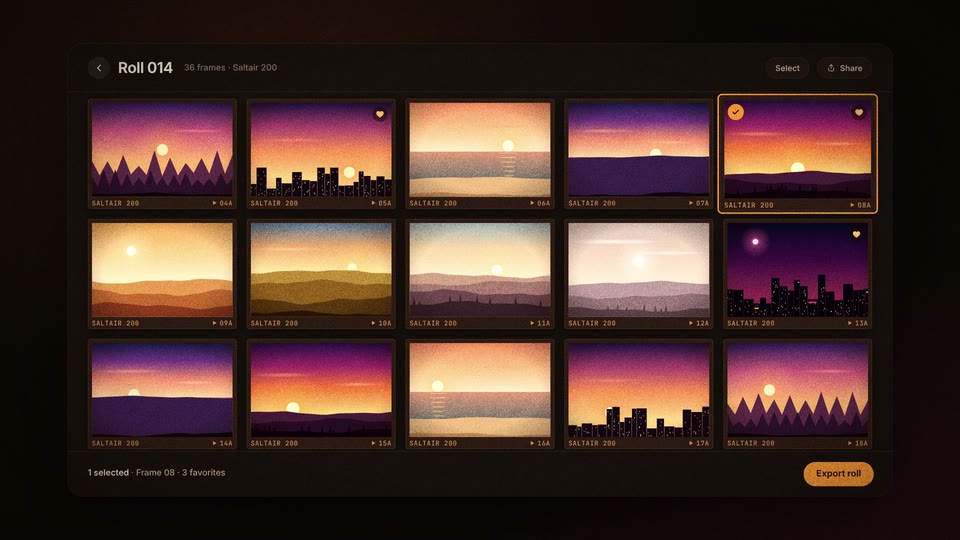
A light leak is the orange, amber and magenta glow that stray light prints on film. This film uses it as a transition: light drifts in from one side, reaches near-white exactly on the cut frame, the scene is swapped on that brightest frame so no hard cut is visible, and then the light recedes while the new scene develops out of the overexposure. The glow is seven large radial gradients with different sizes, colors, paths and eases (the big orange one covers the middle with power3.out, the magenta one turns slowly, a narrow streak sweeps across with power1.inOut, and a deep red one stays on the bottom edge), so the shape reads as organic and not as one mask sliding across. The layer uses screen blending, which only adds light, so dark scenes pick up the warm color and it bleeds in naturally at the edges. Three exposure moves stack around the cut: the blobs, a near-white flash layer (peak opacity 0.98, with a 0.04 s plateau on each side of the cut; the three cuts sit on frames 84, 171 and 249, all inside the plateau) and an exposure lift on the scene itself (brightness 2.3, contrast 0.82, saturation 1.3), so the picture washes out from within. Grain rises from 0.5 to 0.85 during a leak, as it does on real overexposed film. All three scenes are real screens of Grain, a film-look camera app, so the theme and the effect agree: a light leak is a film defect and here it becomes the brand's language. The first leak is triggered by the shutter (pressed at 1.75 s, the glow enters at 1.8 s); the later ones land after each scene has finished its content, and the next scene's elements (gallery frames, the preview) develop out of the overexposure, which turns the transition and the next scene's entrance into one move. There is a single accent color, amber #ff9a2e; the orange and magenta only exist inside the light.
Spec
- Timing
- Film 10.4s. Scene 1 0–2.8s (phone rises 0–1.2s, focus box 0.9s, shutter 1.75s); leak 1 blobs 1.8–4.3s, flash 2.3–3.79s, cut to the gallery at 2.8s; scene 2 2.8–5.7s (frames develop one by one from 3.02s, heart 3.95s, selection 4.35s); leak 2 blobs 4.7–7.2s, flash 5.2–6.69s, cut to the picker at 5.7s; scene 3 5.7–8.3s (stock change at 7.0s); small tail leak blobs 7.5–9.5s, flash 7.9–9.1s, cut to the wordmark at 8.3s; lockup from 8.5s, held to the end (2.1s)
- Easing
- Flash rises power3.in (0.46s) and falls power2.out (0.95s); blobs move horizontally with power3.out / power2.out / power1.out / power1.inOut and vertically with sine.inOut, fade in power2.out and out power2.in; scene exposure lift power3.in (0.55s) and release power2.out (0.9s); UI entrances
cubic-bezier(0.16,1,0.3,1)(expo.out), panels settle power3.out - Camera
- Flat framing with a slow push in each scene: the phone goes 1→1.05x over the whole 2.8s and the picture in the viewfinder 1→1.08x with a slight sideways drift; the gallery and picker panels settle from 1.06x to 1 over 1.5s (power3.out), then push linearly to 1.025x and 1.02x; the lockup pushes 4% over 8.3–10.4s. The phone enters with a -16° Y rotation, perspective 2000px. The leak itself never moves the camera; it only drifts across the frame
- Subject
- Phone 440x900px, radius 72px, screen 420x880px, viewfinder 420x560px (3:4), shutter ring 84px; the viewfinder holds a code-drawn sunset (gradient sky, sun with glow, three silhouette ridges, small pines). Gallery panel 1640x900px with a 5x3 grid of film-bordered frames, each 296x219px (picture 280x187px, 3:2, a 24px bottom strip with edge print and frame numbers 04A–18A). Picker panel with an 800x533px preview on the left, six stocks on the right (Saltair 200, Marigold 400, Dusk 800, Vesper 100, Neon Alley 500T, Cinder 400) and three sliders (Grain, Fade, Halation) under the preview. Seven blobs: orange 1800x1300px, amber 1300x1000px, magenta 1000x1500px, near-white core 900x700px, narrow streak 300x1500px (24px blur), bottom-edge deep red 2200x520px, top-edge amber 800x600px, gradient stops at 0% / 40% / 72% / 100%. Leak 1 enters from the left, leak 2 is mirrored in x and y and enters from the bottom right, leak 3 enters from the right at strength 0.85, time scale 0.8 and without the deep red blob
- Sync
- The three cuts sit at 2.8s, 5.7s and 8.3s (frames 84, 171 and 249), all inside the 0.08s plateau where the flash is at 0.98; blob peaks fall 0–0.3s around the cut; the scene exposure lift starts 0.55s before the cut and ends 0.9s after it; the shutter fires at 1.75s and the glow enters at 1.8s; gallery frames develop one every 0.055s from 3.02s (0.75s each, brightness 2.4→1); the selection box slides to Dusk 800 at 7.0s (0.55s), the preview cross-fades at 7.05s (0.45s) and the sliders move to 72 / 38 / 58 from 7.1s over 0.7s; the flash of leak 2 has already ended at 6.69s
- Style
- Warm black
#0c0806, panels#16100c, text#f6ead7, a single accent amber#ff9a2e; Inter, readouts in JetBrains Mono; the flash layer is a near-white radial gradient#fff8e6→#ffe8bd→#ffc88c; the blob layer uses screen blending; a 384px noise tile re-offset every 1/24s with overlay blending, opacity 0.5 (0.85 during a leak); vignette 50% dark at the corners
Prompt
Build a 10.4-second, 1920x1080, 30 fps film called Light Leak Transition for a fictional product, Grain (a film-look camera app). Palette: background #0c0806, panels #16100c, text #f6ead7, one accent amber #ff9a2e; Inter for the UI. Three scenes are joined by two large light leaks, and a small third leak leads into the lockup. Scene 1 (0–2.8s): a CSS phone 440x900px, radius 72px, screen 420x880px, viewfinder 420x560px showing an SVG sunset drawn in code (gradient sky, sun with glow, three silhouette ridges, small pines) with a thirds grid, a focus box, readouts (ISO 400, 1/125 f/2.8, 07 / 36), a Saltair 200 chip and an 84px shutter ring. On the left a 176px headline, Shoot / it warm., the second line in amber. The phone rises from 130px below with a -16° Y rotation over 1.2s (expo.out) and pushes to 1.05x. The focus box appears at 0.9s; at 1.75s the shutter is pressed (button 1→0.86 in 0.09s, back over 0.35s), the viewfinder blinks black for 0.27s and the counter goes 07→08. Scene 2 (2.8–5.7s): a gallery panel 1640x900px with a 5x3 grid of film frames, each 296x219px with a film border, a 3:2 picture drawn in code and a bottom strip printed with SALTAIR 200 and frame numbers 04A–18A. From 3.02s the frames develop out of overexposure one every 0.055s (0.75s power3.out, brightness 2.4→1). At 3.95s frame 08 (the sunset from scene 1) gets a heart and at 4.35s an amber selection ring and check. Scene 3 (5.7–8.3s): a preset picker with an 800x533px preview on the left (the same sunset), three sliders under it (Grain, Fade, Halation at 40 / 22 / 30) and six film stocks on the right (Saltair 200, Marigold 400, Dusk 800, Vesper 100, Neon Alley 500T, Cinder 400). At 7.0s an amber selection box slides from Saltair 200 to Dusk 800 over 0.55s (expo.out), the preview cross-fades over 0.45s into a darker grade and the sliders move to 72 / 38 / 58. Lockup (8.3–10.4s): an amber rounded-square lens icon, the word Grain (Inter 700, 196px) with letters staggered 0.05s from 8.5s, and the line Film look, in every frame. at 9.0s. The light leak is the core and sits above every scene with screen blending. Let T be a cut (2.8s, 5.7s, 8.3s). It is seven large radial gradients (closest-side, stops at 0% / 40% / 72% / 100%): orange rgb(255,96,18) 1800x1300px, x -900→1500, T-1.0 to T+1.5s, power3.out; amber rgb(255,176,32) 1300x1000px, x -1200→1300, T-0.8 to T+1.4s, power2.out; magenta rgb(255,40,120) 1000x1500px, x 300→1750, rotating -25°→15°, T-0.55 to T+1.3s, power1.out; a near-white core rgb(255,246,222) 900x700px, scale 0.6→1.5, T-0.5 to T+0.9s; a narrow streak rgb(255,130,50) 300x1500px, 24px blur, rotated 14°, x -400→2400, T-0.7 to T+0.9s, power1.inOut; a bottom-edge deep red rgb(224,48,24) 2200x520px; and a top-edge amber rgb(255,160,40) 800x600px. All move vertically with sine.inOut and fade in power2.out and out power2.in, peaking 0–0.3s around the cut. Leak 1 enters from the left, leak 2 is mirrored in x and y, and leak 3 enters from the right at strength 0.85, time scale 0.8 and without the deep red blob. Exposure: a near-white radial gradient layer (#fff8e6→#ffe8bd→#ffc88c) rises to opacity 0.98 over 0.46s (power3.in) from T-0.5s, holds until T+0.04s and falls to 0 over 0.95s (power2.out); the scene swap happens at T, inside the plateau. From 0.55s before the cut the outgoing scene's filter rises to brightness(2.3) contrast(0.82) saturate(1.3) (power3.in), and the incoming scene eases from that state back to normal over 0.9s (power2.out). Grain is a seeded 384px noise tile, overlay blending, opacity 0.5 (0.85 during a leak), offset re-rolled every 1/24s; add a vignette. Drive everything from one paused GSAP timeline.
People describe it as
- A warm glow drifts in from the edge and the picture has already changed when it peaks
- Like an old film camera leaking light: orange, amber and magenta glow washes over and recedes
- Two leaks join the viewfinder, the gallery and the picker
Often confused with
- Wipe and Flash TransitionForeground Wipe & Flash covers the frame with a large blurred object or a center white flash before the scene changes; the leak here is several organic blobs of different colors drifting from one side, with grain and an exposure lift, and the swap lands on the brightest frame.
- Match Cut TransitionMatch Cut keeps the anchor position still and swaps one thing for another; a light leak needs no shared position between the two scenes, because the overexposure hides the cut and the scenes can be completely different.
FAQ
What is a light leak transition?
A light leak transition imitates the glow that stray light prints on film. A warm glow drifts across the frame, brightens until the picture is nearly white, and the next shot appears as the glow recedes. The cut is hidden inside the brightest frame.
How do you make a light leak in HTML and CSS?
Stack several large radial gradients in orange, amber and magenta over the scene with mix-blend-mode screen, move each on its own path and ease, and add a near-white flash layer that peaks on the cut frame. Lift the scene's brightness at the same moment and add film grain with overlay blending.
Is it free to use?
Yes. Motionboard is free and MIT licensed, so you can use and modify the recipes and the films they produce in personal and commercial projects. The licence asks only that copies of the recipe files keep the copyright notice.