11s
Transitions · 11s film
Smash Cut
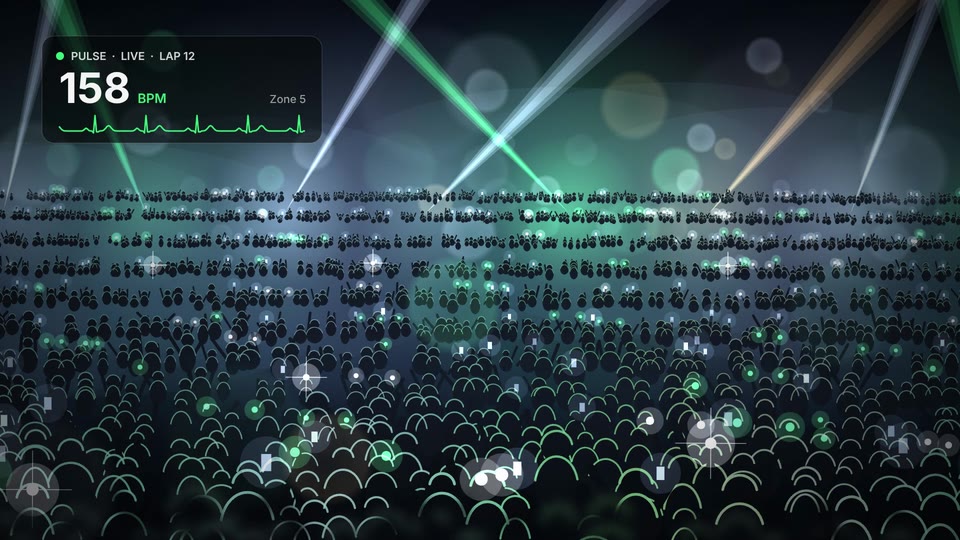
A loud crowd scene full of beams and flashes hard-cuts in one frame to pure black, a white line types in word by word, and then green LEDs light between the lines while the sensor rises out of the dark and shrinks into the mark.
Seen in real launch films
How to make a Smash Cut with Claude Code or Codex
Copy the recipe above and paste it into Claude Code or Codex. The agent installs the skill and builds the shot.
npx skills add krisyangdev/motionboardHow it's built
Draw the loud half on one canvas that is redrawn every frame from timeline time, and make it as busy as you can for 3.5s: a 14-row crowd of near-black silhouettes jumping at 1.9–3.3Hz, 8 beams sweeping ±0.78 rad from lamps at y = 470, soft bokeh in front and behind, 9 strobes, and a handheld camera that pushes from 1.08x to 1.63x with a shake that grows from 0.7 to 2.0 times. Vary every figure's width, height, head size and spacing from a seeded random generator so the rows do not tile. Then hard-cut on frame 105 (3.5s): the scene layer ends and the next layer is pure black, with no fade, and any sound stops on the same frame.
Hold silent black for 0.45s, then fade the words in one at a time: The, most, accurate at 3.95s, 4.15s and 4.35s, a 1s pause, then heart, rate, sensing. at 5.35s, 5.55s and 5.8s. Each word takes 0.45s with power2.out, rising 5px with blur 6px→0, in Inter 500 at 72px on two centred lines at y = 445 and 635. Reserve every word's space from the start so the lines never reflow. Light four 26px green LEDs between the lines at 6.2s and pulse them at 6.8s and 7.35s while the sensor plate rises to 40% opacity over 1.3s, then shrink the sensor into a 210px mark at 7.6s and unfold the wordmark from 8.05s.
Press the copy button to send this recipe to Claude Code or Codex, or install the skill once with npx skills add krisyangdev/motionboard. The agent builds the crowd, the black cut, the typed line and the sensor lockup for your own product, with the accent color #34e27a changed to your brand color. Render an MP4 with HyperFrames, or port the GSAP timeline to your website.
Full recipe
Why it works
A smash cut puts the loudest image next to the quietest one with nothing in between, so the viewer feels the drop on the cut frame itself. The first 3.5s is a crowd, sweeping beams, camera flashes, a heart-rate counter that keeps climbing and a camera that pushes in and shakes harder; after the cut there is pure black and one calm line of white text. The louder the first part, the stronger the drop, so it is packed with motion: hundreds of figures jumping, 8 beams sweeping, 9 strobes, and a push that accelerates. The last strobe sits 2 frames before the cut so the last frame before it is the brightest. The cut lands on a whole frame with no fade and no dissolve frame; if there is sound, it stops on the same frame. Black then stays silent for 0.45s so the contrast can land, and the line types in word by word: The most accurate, a 1s pause, then heart rate sensing., with a pause between the two beats. The product arrives after the words: four green LEDs light up in the gap between the two lines, the sensor plate rises out of the black, and it shrinks into the mark, with the Pulse wordmark after it. The film has one accent color, green #34e27a, and it is the glow sticks in the crowd, the heart-rate trace and the LEDs, which ties the loud half to the quiet half.
Spec
- Timing
- Film 11s at 30 fps. Scene A runs 0–3.5s and cuts to pure black at 3.5s (frame 105) with no fade; black stays silent 3.5–3.95s; line 1 is The at 3.95s, most at 4.15s, accurate at 4.35s; line 2 is heart at 5.35s, rate at 5.55s, sensing. at 5.8s; each word fades in over 0.45s; the green LEDs fade in at 6.2s (0.5s) and pulse at 6.8s and 7.35s; the sensor plate rises from 6.7s over 1.3s; both lines fade out at 7.4s (0.45s); at 7.6s the sensor shrinks into the mark over 0.95s; the wordmark unfolds at 8.05s (0.9s, 0.05s between letters); the tagline fades in at 8.4s (0.4s); wordmark and tagline are in place by 8.8s and hold to the end at 11s
- Easing
- Scene A is driven by one linear clock (ease none) and redrawn every frame from the time; word fade-ins power2.out (0.45s, rising 5px with blur 6px→0); LED fade-in expo.out; plate rise power2.inOut; LED pulses power2.out up and power2.inOut back; shrink to the mark power3.inOut; wordmark expo.out (
cubic-bezier(0.16,1,0.3,1)); the lines fade out power2.in - Camera
- Scene A is handheld: scale
1.08 + 0.55 × (t/3.5)^2.4, accelerating from 1.08x to 1.63x around the origin (960, 700); shake x = sin(47t)×9 + sin(83t+1.3)×6, y = sin(53t+0.7)×8 + sin(97t+2.1)×5, roll sin(31t)×0.006 rad, all three multiplied by an amplitude of 0.7→2.0 (0.7 + 1.3 × t/3.5), with the two front rows pushed 50% further; there is no shake on black: the sensor drifts 0.94→1.02 over 6.2–8.0s (linear) and the whole frame drifts 1→1.035 over 7.6–11.0s (linear) - Subject
- The crowd has 14 rows (row r, d = r/13); figure height s = 10 + 120d² px and the row centre y = 450 + 750 × d^1.2. Each figure is random (seed 11): body width ×0.82–1.22, body height ×0.85–1.2, head ×0.78–1.28, spacing ×0.6–1.35, 7% left out, and each row starts at a different offset. Figures jump at 1.9–3.3Hz with height |sin| × 0.38s. Arms: 22% down, 38% both up, 14% left only, 14% right only, 12% holding a phone (a small pale blue-white screen with a flickering glow); 10% hold a glow stick (green or white). Figures are near-black silhouettes, rgb(26,36,52) on the far rows fading to rgb(6,8,12) on the near rows, with a thin rim light only on the top of the head and shoulders, its color and strength taken from the 8 lamps. The nearest two rows are drawn apart with a 12px Gaussian blur. 8 lamps at x = 120 + 245i with a base at y = 470 each throw one upward beam, 1600px long with a half-angle of 0.05 or 0.075 rad, sweeping ±0.78 rad about vertical at 1.9–3.3 rad/s; each beam is 3 nested wedges (widths 1, 0.62, 0.32 at 34% opacity each) for a soft edge, with a 380px-radius glow at the lamp, plus 6 drifting haze patches and 40 back and 12 front soft bokeh discs (radius 14–54px and 70–180px). A 560x214px heart-rate card sits top left: PULSE · LIVE · LAP 12, BPM climbing 126 to 200, Zone 5 and an ECG trace scrolling at 300px/s. The sensor plate is 776px across with 72 radial ticks, a central disc of radius 176px, two 34x72px photodiodes and four 26px LEDs centred ±28px from the middle; the mark is 210px, the wordmark Inter 600 at 176px and the tagline Inter 400 at 32px
- Sync
- On 3.5s the picture, the heart-rate card and all sound stop on the same frame; the last strobe at 3.44s makes the frame before the cut the brightest; BPM reads 200 at the cut; black stays silent 0.45s before the first word; the LEDs light 0.4s after sensing. appears (6.2s) in the gap between the lines so they never touch a letter; the two LED pulses (6.8s, 7.35s) happen while the plate rises; the wordmark and tagline open while the sensor shrinks into the mark
- Style
- Pure black
#000, one accent green#34e27a(LED core#d4ffd9, glowrgba(70,255,130,0.85)); the scene A sky goes#03040a→#0a1424→#0d1a2cand the beams are cool whitergb(200,220,255), greenrgb(60,240,130)and warm amberrgb(255,190,110); strobesrgb(235,242,255)at up to 42% opacity, each decaying over 0.11s, at 0.4 / 0.9 / 1.35 / 1.8 / 2.2 / 2.55 / 2.9 / 3.15 / 3.44s; vignette to 62% black at the edge; text on black is Inter 500 at 72px, letter-spacing -0.02em, colorrgba(244,244,245,0.95), two centred lines with a 96px line height and line centres at y = 445 and 635, with every word's space reserved from the start so nothing reflows as words appear
Prompt
Build an 11-second, 1920x1080, 30 fps product film called Smash Cut for a fictional product, Pulse (a smart ring whose selling point is the most accurate heart rate). It has one move: the loudest, busiest image hard-cuts in a single frame to pure black and silence, a calm white line types in word by word, and the product appears only after the words. The frame is pure black #000 and the one accent color is green #34e27a. Scene A (0–3.5s) is a code-drawn concert crowd, the loudest part of the film. Use one 1920x1080 canvas redrawn every frame from the timeline time, with no random calls (use mulberry32 with seed 11). The crowd has 14 rows; for row r, d = r/13, figure height s = 10 + 120d² px and row centre y = 450 + 750 × d^1.2. Each figure is random: body width ×0.82–1.22, body height ×0.85–1.2, head ×0.78–1.28, spacing ×0.6–1.35, 7% left out, and each row starts at a different offset so nothing tiles. Every figure jumps at 1.9–3.3 Hz with height |sin| × 0.38s. Arms: 22% down, 38% both up, 14% left only, 14% right only, 12% holding a phone (a small pale blue-white screen with a flickering glow); 10% hold a glow stick (green or white). Figures are near-black silhouettes, rgb(26,36,52) on the far rows fading to rgb(6,8,12) on the near rows, with a thin rim light only on the top of the head and shoulders, taking its color from the nearest lamp. Behind them, 8 lamps at x = 120 + 245i with a base at y = 470 each throw one upward beam, 1600px long with a half-angle of 0.05 or 0.075 rad, sweeping ±0.78 rad about vertical at 1.9–3.3 rad/s; draw each beam as 3 nested wedges (widths 1, 0.62, 0.32 at 34% opacity each) for a soft edge; colors are cool white rgb(200,220,255), green rgb(60,240,130) and warm amber rgb(255,190,110). The sky is a gradient #03040a → #0a1424 → #0d1a2c with 6 drifting haze patches, 40 soft bokeh discs behind the crowd and 12 large ones (radius 70–180px) in front; the nearest two rows are drawn on their own layer with a 12px Gaussian blur. The camera is handheld: scale 1.08 + 0.55 × (t/3.5)^2.4 (to 1.63x) around (960, 700), shake x = sin(47t)×9 + sin(83t+1.3)×6, y = sin(53t+0.7)×8 + sin(97t+2.1)×5, roll sin(31t)×0.006 rad, all multiplied by 0.7→2.0 over the scene. Add 9 white strobes at 0.4, 0.9, 1.35, 1.8, 2.2, 2.55, 2.9, 3.15 and 3.44s (color rgb(235,242,255), peak 42% opacity, 0.11s decay; the last one sits 2 frames before the cut), a vignette to 62% black, and a 560x214px heart-rate card top left: PULSE · LIVE · LAP 12, BPM climbing 126 to 200, Zone 5 and an ECG trace scrolling at 300 px/s. At 3.5s hard-cut: scene A ends on frame 105 and the next layer is pure black, with no fade, dissolve or flash; if you add music, it stops on the same frame. Hold silent black for 0.45s. From 3.95s the words fade in one by one (0.45s, power2.out, rising 5px with blur 6px→0) in Inter 500 at 72px, letter-spacing -0.02em, color rgba(244,244,245,0.95), as two centred lines with a 96px line height and line centres at y = 445 and 635, with every word's space reserved from the start. Line 1: The 3.95s, most 4.15s, accurate 4.35s; pause 1s; line 2: heart 5.35s, rate 5.55s, sensing. 5.8s. Put the product between the lines: at 6.2s four 26px green LEDs fade in (0.5s, expo.out) in a 2x2 grid centred ±28px from the middle, core #d4ffd9, glow rgba(70,255,130,0.85), with a soft green ambient glow; they pulse at 6.8s and 7.35s (scale up to 1.3 in 0.1s, back in 0.3s). From 6.7s the sensor plate rises to 40% opacity over 1.3s (power2.inOut): 776px across, a titanium gradient rim, 72 radial ticks, a central disc of radius 176px and two 34x72px photodiodes; the whole sensor drifts from 0.94x to 1.02x over 6.2–8.0s. At 7.4s both lines fade out (0.45s, power2.in). Ending: at 7.6s the sensor shrinks over 0.95s (power3.inOut) into a 210px mark left of the wordmark and rises to 100% opacity. The Pulse wordmark (Inter 600, 176px, letter-spacing -0.04em) unfolds letter by letter from 8.05s (0.9s expo.out each, 0.05s apart, entering from 60px left with blur 10px); the tagline Accurate to every beat. (Inter 400, 32px, #7f8c85) fades in at 8.4s; the frame drifts 1→1.035 over 7.6–11.0s. Wordmark and tagline are in place by 8.8s and hold to the end.
People describe it as
- The loudest scene cuts to pure black in one frame, then a calm line types in
- The crowd, the beams and the flashes are at full volume, and then there is nothing but white text
- Once the words are done, the product lights up out of the black
Often confused with
- One Word per CutOne Word per Cut also uses hard cuts, but it swaps in a new product screen at every cut with the word fixed in the centre, at 0.5s per cut; a smash cut has one cut, from a very loud image to silent black, and the words type in after it.
- Wipe and Flash TransitionWipe and Flash hides the scene change behind a big out-of-focus object or a bloom that whites out the frame; a smash cut changes the scene in a single frame and the cut itself is the effect.
FAQ
What is a smash cut in a product film?
A smash cut jumps from one scene to a very different one in a single frame, with no fade or dissolve. In a launch film it usually goes from a loud, busy image to silence and black, and the size of the contrast is what makes the next line land.
Where should the cut land?
Land it on a whole frame and end the loud scene on its busiest moment: here a strobe fires 2 frames before the cut at 3.5s and the heart-rate counter reads 200. Hold black for about 0.45s before the first word, so the viewer notices the silence before they read.
Is it free to use?
Yes. Motionboard is free and MIT licensed, so you can use and modify the recipes and the films they produce in personal and commercial projects. The licence asks only that copies of the recipe files keep the copyright notice.