11s
Motionboard recreation · no launch-film original
Opening · 12s film
Star Wars Text Crawl
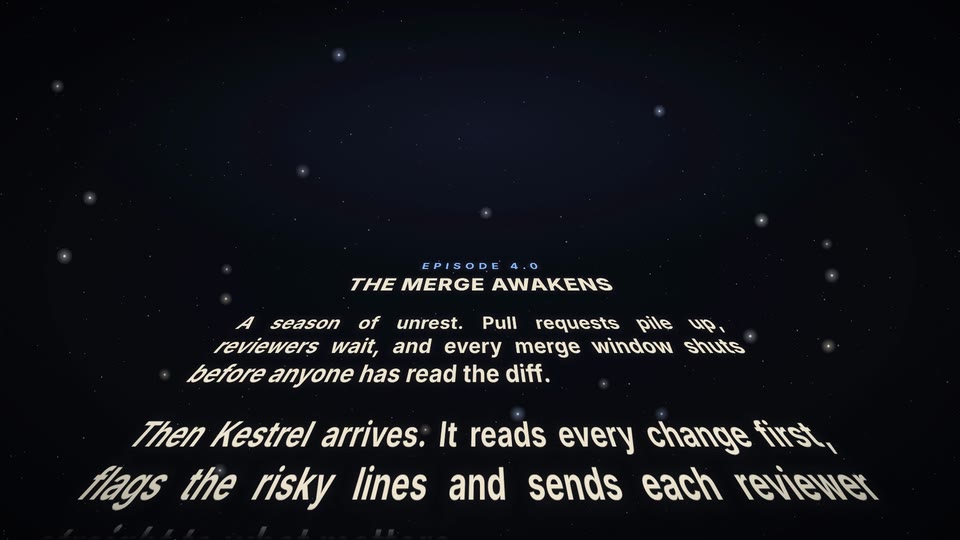
A line of cool-blue text fades in and out on black, then a justified block of cream text with a kicker and a title recedes up a tilted plane over a starfield, the stars rise when the crawl ends, and the Kestrel lockup appears.
Motionboard shot: Release Crawl
How to make a Star Wars Text Crawl with Claude Code or Codex
Copy the recipe above and paste it into Claude Code or Codex. The agent installs the skill and builds the shot.
npx skills add krisyangdev/motionboardHow it's built
Put the text block on a plane tilted with rotateX(45deg) about its bottom edge, inside a container with perspective: 405px and the origin at the frame centre (960px, 540px). The plane is 1700px wide with its pivot line at y=1040px, so the vanishing point lands near y≈135px. Set the text in Inter 700 at 67px on an 84px line, justified, with a 54px kicker and a 92px title above three paragraphs, and fade the top of the layer out with a mask that is transparent above 14% of the frame height and fully visible from 40%.
Move the block up the plane at a constant 210px per second with ease none, starting at 2.7s with the block top 30px past the pivot line, so about 16 lines show at once. Fade a short intro line in at 0.05s and out at 2.7s over 0.3s, and bring the 640-star canvas up from 0.16 to full opacity over 2.2–3.4s. At 9.0s the stars rise by 420px scaled by depth over 3.0s while the crawl fades 9.3–10.2s, then the mark appears at 9.4s, the wordmark at 9.5s and the tagline at 9.7s.
Press the copy button to send this recipe to Claude Code or Codex, or install the skill once with npx skills add krisyangdev/motionboard. The agent builds the starfield, the crawl and the lockup. Replace the kicker, the title and the three paragraphs with your own release notes and swap the cool blue #86b8ff for your accent. Render an MP4 with HyperFrames, or port the GSAP timeline to your website.
Full recipe
Why it works
The text block sits on a plane tilted about its bottom edge, and perspective squeezes it into a trapezoid. Lines at the bottom are large and readable, each line above is smaller than the last and narrower, and that shrinking is the only depth cue the eye needs. The plane moves at one constant speed, so every line spends the same time between appearing and becoming small, and the viewer can predict how long a paragraph stays readable. A mask at the top fades the lines that have become too small to read, which leaves a band of plain stars above the text instead of a pile of fine lines. The intro line is the only centred text in the film. It sets up the story in one sentence before the crawl rises from the bottom edge, so the viewer knows to read next. The stars use depth parallax, and when the crawl is done the camera tilts down and the stars rise, which moves the frame from reading to looking at the lockup. The crawl is warm cream and only the kicker, the intro line and the mark use the cool blue, so the film keeps one accent colour.
Spec
- Timing
- Film 12s. Intro line fades in at 0.05s (0.4s) and out 2.7–3.0s (0.3s); stars go to 0.16 over 0–0.6s and rise to 1 over 2.2–3.4s (1.2s); the crawl starts at 2.7s and runs at a constant 210px/s (the block top starts 30px past the pivot line); the crawl layer fades 9.3–10.2s (0.9s); the dark pocket behind the lockup 9.2–10.2s; mark at 9.4s (0.7s), wordmark at 9.5s (0.8s), tagline at 9.7s (0.6s), held to the end; stars rise 9.0–12.0s (3.0s)
- Easing
- Crawl linear (ease none, constant speed); intro in power2.out and out power2.in; stars power1.out then power1.inOut; crawl fade power1.in; lockup dim power2.out; mark, wordmark and tagline
cubic-bezier(0.16,1,0.3,1)(expo.out); star rise power2.inOut; twinkle on a sine curve - Camera
- The plane tilts about its bottom edge with
rotateX(45deg), pivot line at y=1040px, perspective 405px with the origin at the frame centre (960px, 540px), so the vanishing point sits near y≈135px (540 − 405 × cot 45°). The camera holds still during the crawl; from 9.0–12.0s it tilts down and the stars rise by 420px scaled by depth (nearer stars rise more) - Subject
- Plane 1700px wide, 110px from the left. Text block in Inter 700, 67px on an 84px line, letter-spacing 0.01em, justified (
text-wrap: pretty): an EPISODE 4.0 kicker (54px, tracking 0.36em, accent), the title THE MERGE AWAKENS (92px, 800, one line) and three paragraphs of about 21 words; 84px between the title and the first paragraph, 56px between paragraphs. About 16 lines show at once and capitals at the bottom edge are about 77px tall. A mask is transparent above 14% of the frame height, fully visible from 40%, and fades out from 94% at the bottom. The sky is 640 seeded stars (seed 19770525) plus 20 brighter stars with a glow, depth 0.15–1, drifting 3px per second scaled by depth and twinkling on a sine - Sync
- The intro line starts to fade at 2.7s, the same moment the crawl starts; the stars finish brightening at 3.4s, while the first line is still rising from under the bottom edge; the dark pocket starts at 9.2s, 0.1s before the crawl fades (9.3s), so the background behind the lockup is already dark while the last lines go
- Style
- Background
#06070b, crawl text warm cream#efe5cf, one cool accent#86b8ff(intro line, kicker, mark), with none of the classic crawl yellow; Inter only: body 700, title 800, intro line 500 at 62px; mark is a 104px rounded square with two dark upward chevrons, wordmark Kestrel 156px 700, tagline Code review, minus the wait. at 40px 500; vignette
Prompt
Build a 12-second, 1920x1080, 30 fps dark product film called Release Crawl, in the style of the 1977 space-opera opening crawl: a justified block of text recedes up a tilted plane. The fictional product is Kestrel, a code-review tool. Use no film logo, name or marks, and no classic crawl yellow. Background #06070b, crawl text warm cream #efe5cf, one cool accent #86b8ff, Inter only. Starfield: one 1920x1080 canvas redrawn every frame from timeline time (tween a dummy object across the whole timeline with onUpdate: render(tl.time()); no requestAnimationFrame). Generate 640 stars with mulberry32 seed 19770525, each with a depth 0.15–1, a radius, a brightness and a twinkle frequency, mostly white-ish (240,244,255) with some warm (255,238,214) and cool (186,212,255). Add 20 brighter stars (radius 1.7–2.7px, glow 7x the radius). Each star drifts up 3px per second times its depth, wrapping, and twinkles with alpha × (0.78 + 0.22 × sin(t × frequency + phase)). Canvas opacity goes 0 to 0.16 over 0.6s, then from 2.2s to 1 over 1.2s (power1.inOut). Intro line: centred, two lines, Inter 500, 62px on an 88px line, letter-spacing 0.012em, accent #86b8ff: Two sprints ago, in a repo / far, far away… It fades in from 0.05s over 0.4s (power2.out, scale 0.985 to 1) and fades out from 2.7s over 0.3s (power2.in). Crawl: an outer container with perspective: 405px and perspective-origin 960px 540px; inside it a plane 1700px wide, 110px from the left, with its top edge at y=1040px, transform-origin 50% 0 and transform: rotateX(45deg), which puts the vanishing point near y=135px. The text block is anchored above the plane's pivot line in Inter 700, 67px on an 84px line, letter-spacing 0.01em, text-align: justify, text-wrap: pretty, upright. Content in order: the kicker EPISODE 4.0 (54px on a 72px line, tracking 0.36em, centred, accent); the title THE MERGE AWAKENS (92px on a 108px line, 800, tracking 0.04em, one line, centred, 20px below the kicker); then three paragraphs of about 21 words each, the first 84px below the title and 56px between paragraphs, a release note told as an epic: the review backlog, Kestrel reading every change first and flagging risky lines, then version 4.0 shipping with inline suggestions, faster diffs and a queue that never stalls. Wrap the crawl layer in a vertical mask: fully transparent above 14% of the frame height, fully visible from 40%, fading out from 94% at the bottom edge. The block moves up the plane at a constant 210px per second (ease none): at 2.7s its top sits 30px below the pivot line and it ends at y = −300px, so the duration is (block height + 30 + 300) / 210 with the height read from offsetHeight. The crawl layer fades out from 9.3s over 0.9s (power1.in). About 16 lines show at once. Ending: from 9.0 to 12.0s every star rises by 420px times its depth (power2.inOut), which reads as the camera tilting down. From 9.2s a dark radial pocket fades in over 1.0s in the centre (power2.out). The mark appears at 9.4s: a 104px accent rounded square with two dark (#07101f) upward chevrons, rising from 16px below at scale 0.9 over 0.7s expo.out. The wordmark Kestrel (Inter 700, 156px, tracking −0.045em) rises 24px from 9.5s over 0.8s expo.out. The tagline Code review, minus the wait. (40px, 500, cream at 62% opacity) rises 16px from 9.7s over 0.6s expo.out. Hold to the end. Constraints: deterministic, a single paused GSAP timeline; set start values with tl.set and animate with .to tweens that state their end values.
People describe it as
- A justified block of text recedes up a tilted plane and shrinks toward the distance
- One short line fades in and out first, then the whole crawl rises from the bottom edge
- When the crawl ends the stars rise and the product lockup appears
Often confused with
- Scrolling Text AnimationRamble to Summary scrolls one line sideways, speeds it up and squeezes it into a message bubble; Release Crawl moves a whole block at constant speed up a tilted plane and ends on the product lockup.
- 3D Ribbon Text AnimationFolded Ribbon Text folds a title into 3D ribbons and multiplies them into rows; Release Crawl is one block of text that shrinks because the plane is tilted, at a constant speed.
FAQ
How does a perspective text crawl work?
The text sits on a plane tilted back with CSS rotateX, inside a container with a perspective value. The plane narrows toward a vanishing point, so every line is smaller than the one below it. Moving the text up the plane at a constant speed with ease none makes the crawl steady, and a mask at the top hides lines that have become too small to read.
Does this use the Star Wars logo or the film's text?
No. This recipe recreates the style of the 1977 opening crawl, a block of text receding up a tilted plane over stars, with its own text, its own font (Inter) and its own colours. It contains no logo, no marks and no text from the film, and it does not use the classic crawl yellow.
Is it free to use?
Yes. Motionboard is free and MIT licensed, so you can use and modify the recipes and the films they produce in personal and commercial projects. The licence asks only that copies of the recipe files keep the copyright notice.