Device Push-in FocusProduct reveal
Motionboard shot: Outline to Solid
A wireframe or light-drawn outline appears first, then fills into a solid shape or material.
On a pure black background, fade in a light point at top center at 0.45s. Two heads extend symmetrically and draw the outline (a tube about 1.5px wide) from 1.0 to 4.0s on power2.inOut, cubic-bezier(0.65,0,0.35,1), with bloom and a halo on the heads. Use an 18° fov perspective camera, fixed until 6.3s.
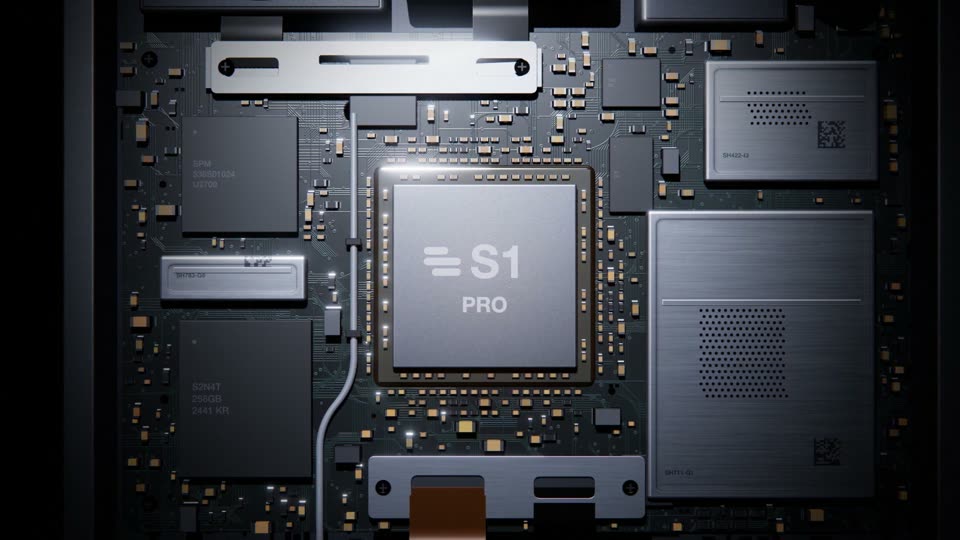
The solid body fades in inside the outline from 3.3 to 4.8s, overlapping the last 0.7s of the draw. The widest highlight, a separate light pass, runs 3.8–5.3s after the body. The outline then fades to 14% over 4.6–5.7s, and a 5% push-in runs 6.3–8.2s. A 2.8s logo version uses a 0.4s wireframe and a 0.6s fill wipe.
Press the copy button to send this recipe to Claude Code or Codex, or install the skill once with npx skills add krisyangdev/motionboard. The agent builds the outline, body and highlight as separate layers. Render an MP4 with HyperFrames, or port the GSAP timeline to your website.
npx skills add krisyangdev/motionboardThe shape comes before the material, so the first thing viewers remember is the silhouette. The light stays the only light source, and when the solid appears its highlight sits where the light comes from. The wireframe stage has very low opacity, so it does not compete with the solid that follows.
cubic-bezier(0.65,0,0.35,1) (power2.inOut: slow, then fast, then slow); body and highlight fade in on the same curve; light point and outline fade sine.inOut; push power2.in; the fill wipe uses power2.inOutrgb(214,235,255)), ACES tone mapping at exposure 1.2, bloom, 0.016 grain; the logo version uses a white background with a gray wireframe (#b4b4b6, 1.5px), a black solid (#0b0b0c) wiping in from left to right, and construction lines at 10% opacityBuild a product opening called Outline to Solid. Pure black background, 18° fov fixed camera. A point of light fades in at the top center over 0.45–1.0 seconds, then from 1.0s two heads extend symmetrically to both sides, tracing the full outline of your product down to the bottom center, with line width about 1.5px and bloom plus a halo on the heads. The outline draw uses power2.inOut (cubic-bezier(0.65,0,0.35,1)) and takes 3 seconds. When the outline is nearly closed (3.3s), the solid product fades in inside it over 1.5 seconds, and the wide highlight, a separate light pass from above, reaches full brightness 0.5 seconds after the body (3.8–5.3s). The outline fades to 14% over 4.6–5.7s and a small LED comes on at 5.5–6.1s. Then hold still until 6.3s and push in slowly by 5% (power2.in) until 8.2s. For a logo (a 2.8-second cut on white): fade in a gray wireframe and 10%-opacity construction lines over 0.4 seconds, then wipe in a black solid from left to right over 0.6 seconds with power2.inOut, fade the wireframe and construction lines out, and scale the lockup 1.00→1.03 across the cut.
The shape first appears as a line drawing, such as a wireframe or a path drawn by light, and then fills with a solid surface or material. The viewer reads the silhouette before the material.
In this film the outline fades to 14% between 4.6 and 5.7s, after the body is in. The faint line stays as a silhouette cue while the solid takes over.
Yes. Motionboard is free and MIT licensed, so you can use and modify the recipes and the films they produce in personal and commercial projects. The licence asks only that copies of the recipe files keep the copyright notice.