11s
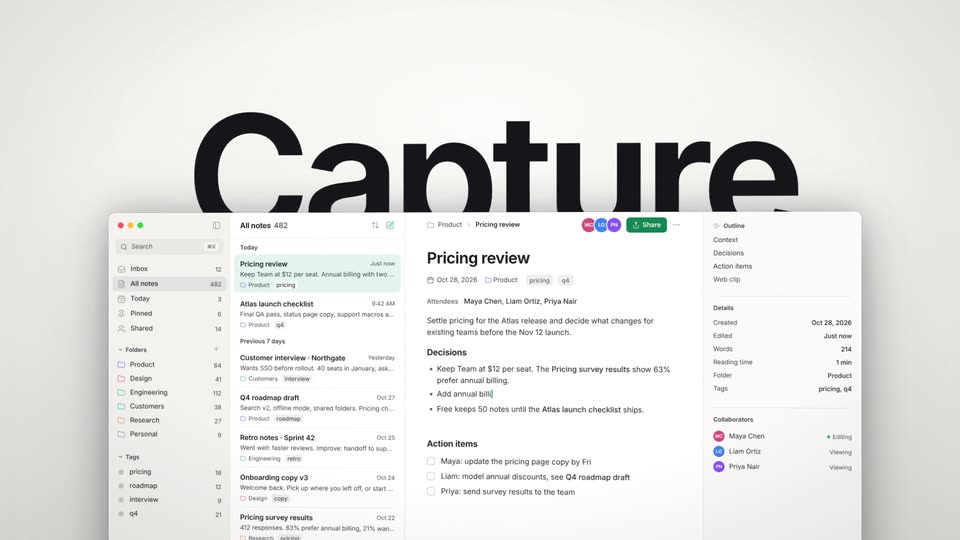
Opening · 11s film
Text Behind Object Effect
A giant headline sits behind a product window and the window covers its lower edge. The window holds still while each feature swaps the headline: the old word sinks behind it, the new word rises from behind it, and the app content changes on the same frame.
Motionboard shot: Headline Behind Product
Seen in real launch films
How to make a Text Behind Object Effect with Claude Code or Codex
Copy the recipe above and paste it into Claude Code or Codex. The agent installs the skill and builds the shot.
npx skills add krisyangdev/motionboardHow it's built
Build two layers in one 3D world with 2600px perspective. Put the headline 420px behind the window and scale it 1.1615 to cancel the perspective shrink. Use Inter 650 at 340px with -0.045em spacing, and place the 1500x900px window so its top edge, at y 425px, covers about a quarter of the letter height.
Turn the whole world from rotateY -4deg to +4deg over 11s so the back headline shifts against the window. Swap the word at the window edge: the old word sinks 230px in 0.3s with power3.in, and once it is hidden the new word rises 230px in 0.9s with expo.out. Change the window content and push the camera to 1.10x on the same frame as the new word.
Press the copy button to send this recipe to Claude Code or Codex, or install the skill once with npx skills add krisyangdev/motionboard. The agent builds the layers, the two feature swaps and the closing wordmark. Render an MP4 with HyperFrames, or port the GSAP timeline to your landing page hero.
Full recipe
Why it works
The headline and the window sit on two layers, so when the camera turns slowly the back layer moves about 60px less than the window and the viewer reads real depth from parallax. The window covers only about a quarter of the lowercase letter height, so the word stays readable. Each swap happens at the window's top edge, so the eye never leaves one spot, and the headline word, the window content and the camera push start on the same frame, which ties each word to one feature.
Spec
- Timing
- Film 11s. Headline settles 0–1.2s, window rises 0.3–1.45s (1.15s, 34 frames); typing 1.45–2.4s (40 characters), task tick 2.5s, web clip card 2.62s (0.45s). First swap: old word sinks 3.0–3.3s (0.3s), new word rises for 0.9s from 3.32s, window content changes on the same frame; hover card appears 4.7s and leaves 5.3s. Second swap: sink 5.5–5.8s, rise 5.82–6.72s, command palette opens 5.82s already listing 6 recent notes; query typed 6.15–6.9s, matched results replace the recents at 7.0s, answer streams 7.1–7.75s. Finish: Recall sinks 8.2–8.5s (230px, power3.in), palette closes 8.3s, wordmark rises 8.52–9.42s, window sinks 8.45–9.45s (1.0s), icon 8.75s, tagline 9.1s (after the window's top edge has sunk below it, 0.55s rise), hold to 11s with about 1.6s of settled wordmark and about 1.35s of settled tagline
- Easing
- Rises and word swaps
cubic-bezier(0.16,1,0.3,1)(expo.out); old word sinks with power3.in (0.3s); the closing window sink uses power3.inOut; camera pushes and the closing pull-back both use expo.out, with a 3px blur added for the first 0.12s of each push (2px on the pull-back) and removed over 0.3s; the world rotation is linear - Camera
- 3D world with 2600px perspective: the headline layer sits 420px behind the window and is scaled 1.1615 to cancel the perspective shrink, so it looks the same size from the front. The whole world turns from rotateY −4° to +4° at constant speed over 11s, with a slow push 1.00→1.03. The window rises from below the frame (y 800px) with rotateX 10°→0 and stays opaque throughout. On each swap the camera pushes fast: from 3.32s, 0.7s to 1.10x on the right panel, with the window's left edge about 55px outside the frame, then from 5.82s, 0.7s to 1.12x on the palette, then from 8.3s a 0.9s pull-back to full frame
- Subject
- Headline Inter 650, 340px, letter-spacing −0.045em, no punctuation; window 1500×900px at (210,425), bottom 245px off-frame. Its top edge covers the letters by about 51px, a quarter of the letter height. The window is a three-pane notes app: sidebar 248px, note list 352px, editor 590px, right panel 310px, body text 12.5–15px, secondary text 10.5–12px, note title 31px, section headings 17px, palette query 18px, answer text 15.5px; header collaborator avatars 28px, right-panel collaborator list avatars 22px. Ending: the app icon is a 100px emerald rounded square (23px radius, gradient
#17c585to#0a8a5c, white H), centred, top at y 70px; the tagline "Notes that remember." is Inter 500 at 32px in#7a7b83, centred, top at y 520px. The headline text box starts at y 182px with 340px line height, so the window's top edge at y 425px covers about 51px of the letter bottoms - Sync
- First swap (3.32s): the right panel changes from outline to linked notes, six links turn accent every 0.1s from 3.42s, ten graph lines draw every 0.07s from 3.52s. The cursor moves in 4.1–4.65s and stops about 8px below the link text so the link stays readable. When the hover card appears (4.7s) the matching graph node rings on the same frame and its graph edge thickens to 2.4px. Second swap (5.82s): the new word, the command palette and the camera push start on the same frame, and the window dims by 16%
- Style
- Light stage gradient
#f3f2eeto#e9e7e2, headline ink#17171b, one accent emerald#0f9d68(links, selected row, icon); white window with#e7e6e3hairlines and a#f3f2efsidebar, four layered soft shadows, soft corner vignette
Prompt
Build an 11-second product opener called Headline Behind Product for a fictional Mac notes app named Halden. Light stage (gradient #f3f2ee to #e9e7e2), 1920x1080, 30fps. Put two layers in one 3D world with 2600px perspective: the headline layer sits 420px behind the window (translateZ(-420px), scaled 1.1615 to cancel the perspective shrink), set in Inter 650 at 340px with letter-spacing -0.045em, ink #17171b, text box top at y 182px with 340px line height, centred, with no punctuation after the word; the window layer is a 1500x900px macOS-style window that stays fully opaque, with its top-left at (210,425) and its bottom 245px off-frame, so its top edge covers about a quarter of the letter height. The window is a three-pane notes app: sidebar 248px (inbox, folders, tags with counts), note list 352px, editor 590px, right panel 310px, filled with real work content (Pricing review, Atlas launch checklist, Maya Chen) with body text 12.5-15px, secondary text 10.5-12px, note title 31px, section headings 17px, palette query 18px, answer text 15.5px, header avatars 28px and collaborator-list avatars 22px, with grey text at least 4.5:1 against white. Turn the whole world from rotateY -4deg to +4deg at constant speed over 11s with a slow push 1.00 to 1.03, so the back headline shifts against the window. Timeline: 0.3-1.45s the window rises from below the frame (y 800px to 0, rotateX 10deg to 0, expo.out); 1.45-2.4s a 40-character bullet types in the editor; 3.0-3.3s the headline Capture sinks 230px (power3.in) behind the window, and once it is fully hidden Connect rises from behind it at 3.32s (expo.out, 0.9s), so only one word is on screen in any frame; on the same frame the right panel becomes linked notes, six links turn accent every 0.1s, ten graph lines draw every 0.07s and the camera pushes to 1.10x in 0.7s (expo.out, 3px blur for the first 0.12s, leaving the window's left edge about 55px outside the frame); the cursor moves in 4.1-4.65s and stops about 8px below the link text; at 4.7s a hover card opens and the matching graph node rings and its edge thickens to 2.4px on the same frame, and the card leaves at 5.3s; 5.5-5.8s the word sinks and Recall rises at 5.82s (0.9s), with a command palette opening on the same frame (background dimmed 16%, six recent notes listed from the first frame) and the camera pushing to 1.12x in 0.7s; 6.15-6.9s a question types in, at 7.0s the recents are replaced by matched results, 7.1-7.75s the answer streams word by word with three sources; Recall sinks 230px (power3.in) behind the window 8.2-8.5s, at 8.3s the palette closes, and the Halden wordmark rises 8.52-9.42s, the window sinks 210px over 1.0s with power3.inOut, the camera pulls back to full frame in 0.9s (expo.out, 2px blur), the app icon appears at 8.75s (100px emerald rounded square, 23px radius, gradient #17c585 to #0a8a5c, white H, centred, top at y 70px) and the tagline "Notes that remember." rises at 9.1s, after the window top has sunk below it (Inter 500, 32px, #7a7b83, centred, top at y 520px, 0.55s), then hold to 11s. Use plain HTML elements and GSAP on one paused timeline.
People describe it as
- A giant headline hides behind the app window and the window covers its lower edge
- The product holds still while the headline words swap behind it
- The window content changes on the same frame as the headline word
Often confused with
- Text–Object InterleaveText–Object Interleave has a 3D product rise in front of the type and lets words pass through an object; Headline Behind Product uses a real app window that holds still while only the word and the window content change.
- 3D Tilted UI with Depth of FieldTilted UI with Depth of Field shoots one interface at an angle with only the active row in focus; Headline Behind Product shows the whole window and builds the shot on the occlusion between the window and a giant headline.
FAQ
What is a text behind object effect?
It places a headline on a layer behind the main subject so the subject covers part of the letters. Here the subject is an app window, the headline keeps changing, and a slow camera turn shifts the two layers by about 60px against each other.
How do you keep the headline readable behind the window?
Cover only the bottom of the letters. In this film the window edge cuts about 51px of the letter height, roughly a quarter, and the words are short enough to stay inside the 1500px window width.
Is it free to use?
Yes. Motionboard is free and MIT licensed, so you can use and modify the recipes and the films they produce in personal and commercial projects. The licence asks only that copies of the recipe files keep the copyright notice.