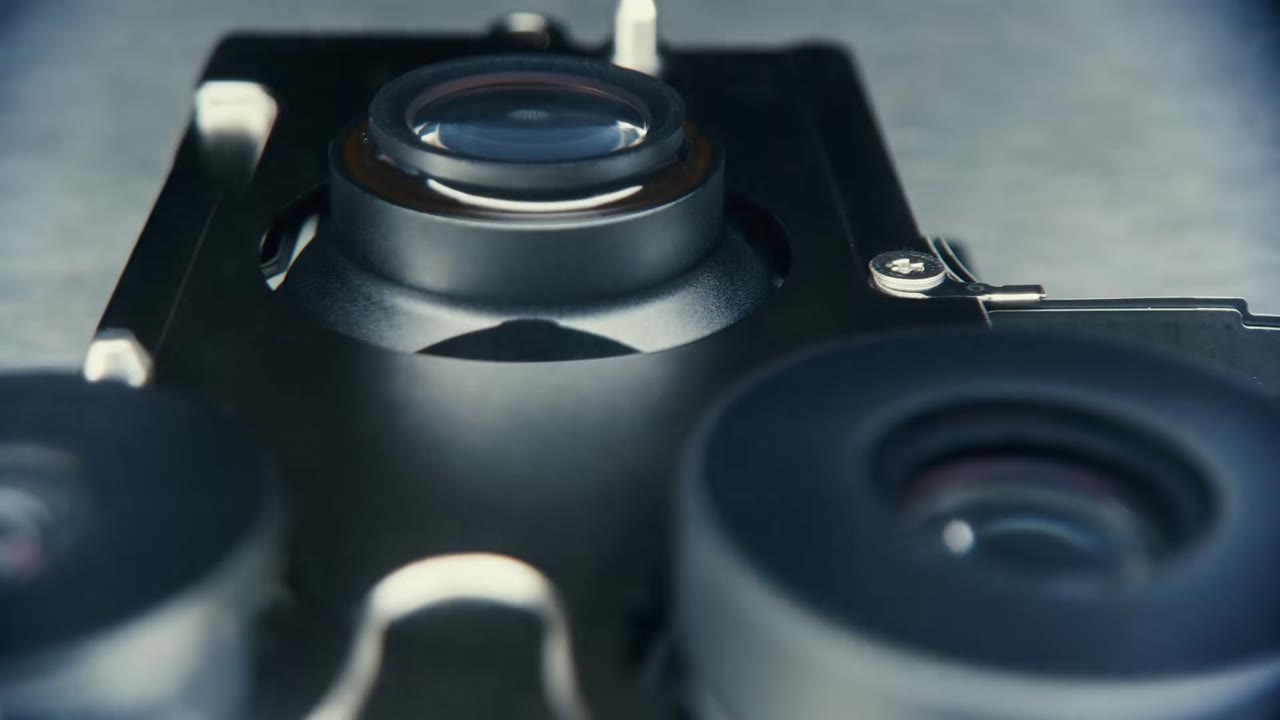
10s
Product reveal · 11.8s film
Exploded View Animation
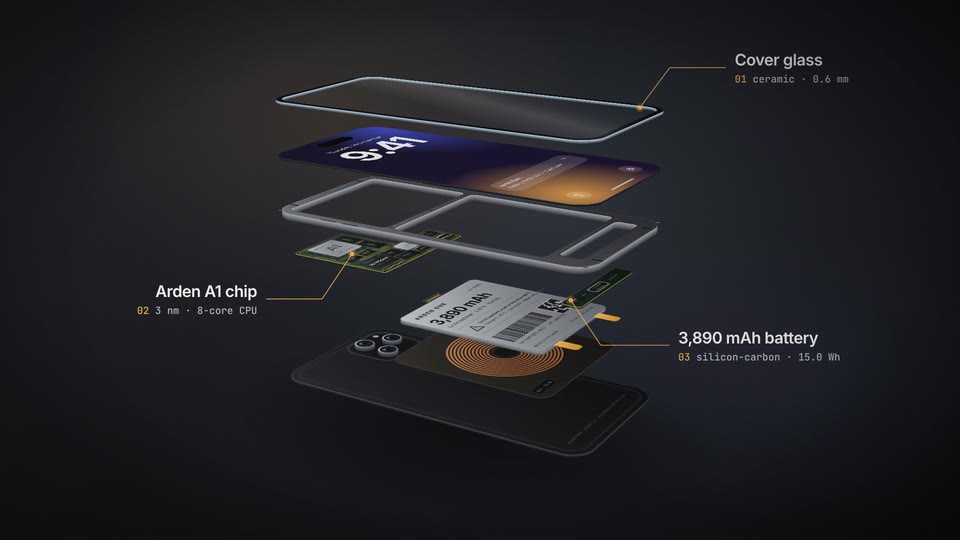
A phone's cover glass, display, frame, logic board, battery, wireless coil and back glass separate in the air one by one while three callouts name the glass, the chip and the battery. The top three layers fade, the camera dives into the board and pulls out, and the seven layers close from the back up into the whole phone beside the Arden One lockup.
Seen in real launch films
How to make a Exploded View Animation with Claude Code or Codex
Copy the recipe above and paste it into Claude Code or Codex. The agent installs the skill and builds the shot.
npx skills add krisyangdev/motionboardHow it's built
Stack seven 360x756px layers on one axis in a CSS 3D stage with perspective 2400px and separate them only on z: closed at 21, 14, 9, 4, 4, -6 and -9px, open at 420, 300, 180, 80, -20, -110 and -210px. Start each layer between 1.0s and 1.32s, the cover glass first and the logic board last, and ease it over 1.7s with expo.out. Tilt the camera from 46° to 72° by 2.9s so the gaps between layers show, and pull back to -230px.
Add three callouts at 2.7s, 3.0s and 3.3s. Each leader takes 0.7s to draw, is re-projected to its part every frame and fades 4.1–4.5s. Fade the cover glass, display and frame out from 4.35s and lift them 100px, push the camera 4.6–5.4s to +1250px with its pivot on the chip, hold on the board until 6.9s and pull out to -200px by 7.65s. Bring the top three layers back from 7.3s, then close all seven from the back glass at 7.55s, each over 1.05s with cubic in-out, finished at 9.14s.
Press the copy button to send this recipe to Claude Code or Codex, or install the skill once with npx skills add krisyangdev/motionboard. The agent builds the seven layers, the callouts and the camera keys. Slide the phone 420px right over 8.2–8.9s and bring in the amber mark, the name Arden One and the tagline from 8.4s. Render an MP4 with HyperFrames, or port the GSAP timeline to your website.
Full recipe
Why it works
The seven layers share one axis with identical x and y and are spaced only on z, so the viewer reads one phone lifting apart and settling back together. They do not move as a block: the separation starts are staggered across 1.0–1.32s and each layer eases with expo.out over 1.7s, fast first and slow at the end; closing runs in the reverse order, back glass first and cover glass last, with a 1.05s cubic in-out, a different rhythm from the separation, so it reads as assembly. The camera tilts to 72° while the layers separate so the gaps between them show; to see the board, the cover glass, display and frame first fade and rise 100px and only then does the camera dive in, so nothing above the board blocks it. Callouts arrive one at a time, 0.3s apart, and each leader end is re-projected every frame to its part's current position, so it stays attached while the part rises; the callout text matches what is printed on the parts (A1 · 3NM · 8-CORE on the chip lid, 3,890 mAh on the battery label). The callouts fade 4.1–4.5s and the cover glass waits until 4.35s to rise. Every layer is drawn with edge thickness and real detail (traces, chips and raised packages on the board, a label and orange pull tabs on the battery, copper on the coil), so the close-up on the board holds up. There is one accent color, amber #f5b04a.
Spec
- Timing
- Film 11.8s. Fade in from black 0–0.9s; the seven layers start separating 1.0–1.32s (cover glass 1.0s, back glass 1.05s, display 1.1s, coil 1.14s, frame 1.2s, battery 1.26s, logic board 1.32s), each over 1.7s; camera tilts to 72° by 2.9s; three callouts appear at 2.7s, 3.0s and 3.3s (leaders draw over 0.7s) and fade 4.1–4.5s; cover glass, display and frame fade out (0.55s) and rise 100px from 4.35s, 4.45s and 4.55s; camera dives into the logic board 4.6–5.4s, holds on it until 6.9s and pulls out 6.9–7.65s; the three layers fade back from 7.3s, 7.4s and 7.5s (0.5s); the seven layers close from the back glass to the cover glass 7.55–9.14s, each over 1.05s; lockup mark at 8.4s, name at 8.5s, tagline at 8.75s; highlight 9.0–10.3s; held to the end at 11.8s
- Easing
- Separation expo.out (1.7s); closing cubic in-out (1.05s, the power3.inOut curve); camera tilt, azimuth, dolly and pan use monotone cubic interpolation between keyframes with no overshoot; the glass, display and frame fade and rise, callout fade-in and leader draw use smoothstep; mark, name and tagline expo.out; fade from black power1.out
- Camera
- CSS 3D stage with perspective 2400px; tilt is rotateX (0° faces the screen) and azimuth is rotateZ. Tilt: 46° over 0–0.9s, 72° at 2.9s, 70° at 4.6s, 50° at 5.2s, 46° at 5.8s, 42° at 6.9s, 54° at 7.4s, 48° at 8.4s, 36° at 9.0s, 16° at 10.2s, 15° to the end. Azimuth: −36° at 0s, −38° at 2.9s, −62° at 4.6s, −24° at 5.4s, −10° at 6.0s, +5° at 6.9s, −14° at 7.4s, −26° at 8.4s, −8° at 10.2s. Dolly (negative pulls back): 0 at 0.9s, −230px at 2.9s, −120px at 4.6s, +1250px at 5.4s, +1400px at 5.9s (about 2.4x), +1000px at 6.9s, +250px at 7.25s, −200px at 7.65s, −100px at 9.0s, 0 at 10.2s. The orbit pivot moves from the centre of the stack to the chip on the logic board (x 93, y 93, z 80) over 4.6–5.4s, drifts to (200, 213, −20) over 5.6–6.9s, releases over 6.9–7.3s and is back at the centre by 8.1s. The phone slides right: −34px at 2.9s, 0 at 5.4s, +380px at 8.2s, +420px at 8.9s and held
- Subject
- Seven phone layers, each 360x756px with 52px corners, moved only on z: cover glass, display (lock screen 9:41), metal frame, logic board, battery, wireless coil and back glass, top to bottom. Closed z is 21, 14, 9, 4, 4, −6, −9px; open z is 420, 300, 180, 80, −20, −110, −210px. Each layer has 1–7 copies stacked 2px apart behind it for edge thickness (cover glass 3, display 2, frame 7, board 2, battery 4, coil 1, back 3). The board is a dark green PCB with gold traces, 11 chips and 5 raised packages, the A1 package being 100x100px with an 86x86px lid; the battery is 300x344px printed 3,890 mAh with two orange pull tabs; the coil is 12 turns of copper; the back glass has three 48px lenses. While open, the layers underneath carry a shade of 0.16–0.58 opacity. An 800x1200px radial shadow sits under the phone at z=−300px. Three callouts: Cover glass (01 ceramic · 0.6 mm, pointing at the lower right corner of the glass, text on the right), Arden A1 chip (02 3 nm · 8-core CPU, pointing at the chip, text on the left) and 3,890 mAh battery (03 silicon-carbon · 15.0 Wh, pointing at the battery's right edge, text on the right)
- Sync
- Each callout's leader end is re-projected every frame to its part's current z, so it stays attached while the part rises; callout text matches what is printed on the parts (A1 · 3NM · 8-CORE on the chip lid, 3,890 mAh on the battery label, Battery health 100% · 3,890 mAh in the lock-screen notification); all callouts are gone by 4.5s and the cover glass only starts to rise at 4.35s, so a leader never sits on a moving glass; as the cover glass, display and frame fade, the shade they cast on the layers below clears with them, so the board is bright in the close-up; the layers close from the back glass up and the cover glass lands last, and when the mark appears at 8.4s the phone has already slid about 390px to the right, leaving the left side for the lockup; the 9.0s highlight and the 9.06s settle land as the last two layers close (9.02s and 9.14s)
- Style
- Background
#09090bwith a radial gradient (#2a2d37→#171920→#0b0b0e, centred at 58% and 40% of the frame), a 10% amber glow at the upper left and a 7% blue glow at the lower right that shift with the azimuth; one accent amber#f5b04a; callout title Inter 600 32px white, subtitle JetBrains Mono 20px at 70% white, number in amber; leader 1.6px with a 4.5px dot and a 9px halo at 22%; mark an 88px amber rounded square, name Arden One in Inter 600 156px with -0.045em tracking, tagline 40px#9b9ca4; grain at 7% opacity re-rolled every 3 frames and a vignette reaching 58% at the edges
Prompt
Build an 11.8-second, 1920x1080, 30 fps dark product film called Exploded View Animation for a fictional product, Arden One (a phone). The background is a radial gradient (centre #2a2d37, through #171920 to #0b0b0e at the edges, base #09090b), the only accent color is amber #f5b04a, the font is Inter and callout subtitles use JetBrains Mono. Use CSS 3D: a stage with perspective 2400px and one rig container that acts as the camera (translate3d, rotateX for tilt, rotateZ for azimuth). Inside it stack seven phone layers on one axis, each 360x756px with 52px corners, and from then on change only each layer's translateZ. Top to bottom: cover glass (a thin bright border), display (a lock screen in a dark blue-violet to orange gradient with the time 9:41, Thursday, 26 November, and a notification Arden Care / Battery health 100% · 3,890 mAh), metal frame (screw bosses, antenna breaks), logic board (dark green PCB, gold traces, 11 chips, a raised A1 chip package of 100x100px whose lid is printed ARDEN A1 3NM · 8-CORE, plus a modem, a shield can and a connector), battery (light grey metal, printed 3,890 mAh and Li-ion polymer · 3.87 V · 15.0 Wh, with two orange pull tabs), wireless coil (a ferrite plate with 12 turns of copper) and back glass (three lenses of 48px). Give each layer 1–7 copies stacked 2px apart behind it for edge thickness and lay an 800x1200px radial shadow under the phone at z=-300px. Closed, the seven layers sit at z 21, 14, 9, 4, 4, -6, -9px; open, at 420, 300, 180, 80, -20, -110, -210px. While open, the layers underneath carry a shade of 0.16–0.58 opacity, but only while layers above cover them. Timeline: fade in from black 0–0.9s; the layers start separating between 1.0s and 1.32s (cover glass 1.0, back glass 1.05, display 1.1, coil 1.14, frame 1.2, battery 1.26, board 1.32), each over 1.7s with expo.out. The camera tilt goes from 46° to 72° over 0.9–2.9s, the azimuth from -36° to -38° and the dolly back to -230px. Three SVG callouts with leader lines (a 1.6px amber line, a 4.5px solid dot with a 9px translucent halo, a 60px slanted kink and then a horizontal run): at 2.7s Cover glass (01 ceramic · 0.6 mm, pointing at the lower right corner of the glass, text on the right), at 3.0s Arden A1 chip (02 3 nm · 8-core CPU, pointing at the chip, text on the left) and at 3.3s 3,890 mAh battery (03 silicon-carbon · 15.0 Wh, pointing at the battery's right edge, text on the right). Each leader draws over 0.7s, the title is 32px 600 white, the subtitle 20px monospace and the number amber; re-project each leader's end to its part's current z every frame; fade all three out over 4.1–4.5s. At 4.35s, 4.45s and 4.55s the cover glass, display and frame fade out one after another (0.55s) and rise 100px, and the shade they cast on the layers below clears with them. From 4.6 to 5.4s the camera dives into the board: move the orbit pivot to the chip (x 93, y 93, z 80), tilt 50°, azimuth -24°, push the dolly to +1250px, reach +1400px at 5.9s (about 2.4x), hold on the board until 6.9s while the pivot drifts to (200, 213, -20), then pull out to -200px by 7.65s. The three top layers fade back and drop at 7.3s, 7.4s and 7.5s (0.5s). From 7.55s the seven layers close from the back glass to the cover glass, each over 1.05s with cubic in-out (starts 7.55, 7.63, 7.71, 7.79, 7.87, 7.97, 8.09), finished at 9.14s. Interpolate the camera values between keyframes with a monotone cubic so nothing overshoots. Slide the phone 420px right over 8.2–8.9s; from 8.4s the lockup comes in with expo.out: an 88px amber rounded-square mark, at 8.5s Arden One (156px, 600, -0.045em tracking) and at 8.75s the tagline Built from the inside out. (40px, #9b9ca4). A highlight sweeps the cover glass over 9.0–10.3s, the camera gives a 16px settle from 9.06s, the tilt eases to 16° and holds to the end. Finish with 7% grain re-rolled every 3 frames and a vignette.
People describe it as
- The parts of the phone hang in the air one layer at a time with gaps between them
- Leader lines point at the chip and the battery and give their specs
- The glass fades, the camera drops onto the board and pulls out, and the parts close back into the phone
Often confused with
- X-Ray EffectX-ray Dissolve cross-dissolves the inner structure into the outer shell from one camera position and the parts never leave their place; Exploded View Animation pulls the parts apart along one axis so each layer shows on its own, then puts them back together.
- Macro Pull-out RevealMacro Pull-out Reveal stays at extreme close range and ends on one pull-back to the whole device; here the device itself splits into seven layers, the camera dives into the board and pulls out, and the layers then close.
FAQ
What is an exploded view animation?
An exploded view separates the parts of a product along one axis so each layer can be seen on its own, and a film usually puts them back together afterwards. In a launch film it shows what is inside a device and how the parts stack.
How do you make an exploded view in HTML and CSS?
Put every layer in a preserve-3d stage with the same x and y and different translateZ values, then animate only translateZ from the closed value to the open value. Stagger the start times so the layers do not move as one block, add a few copies spaced 2px apart behind each layer for edge thickness, and re-project each callout's anchor point every frame so its leader line follows the layer.
Is it free to use?
Yes. Motionboard is free and MIT licensed, so you can use and modify the recipes and the films they produce in personal and commercial projects. The licence asks only that copies of the recipe files keep the copyright notice.